Saturday, November 19, 2016

LAD #14

President Abraham Lincoln
In his first inaugural address, Abraham Lincoln said that, as president, he does not have the power to abolish slavery. He also said that no state can lawfully secede from the Union, but still asked the Southern states to avoid war. Lincoln also voiced his opinion that secession itself was impractical since the sections cannot be separated "beyond the reach of each other." Lincoln finished by saying that Americans need to think about what they do, and "nothing valuable can be lost by taking time." Also, the issue of Civil War is not in his hands, but the hands of the dissatisfied Americans. If there is a war between the North and the South, it would be started by the South. Lastly, Northerners and Southerners need not be enemies, rather they should be friends.
President John F. Kennedy
Lincoln saying that the issue of Civil War is not in his hands is similar to John F. Kennedy telling Americans "ask not what your country can do for you - ask what you can do for your country." The similarity is that the presidents are telling the people in their inaugural address that they are in control, and the people have the power to dictate the course of the country.

Sunday, November 13, 2016

LAD #13: Calhoun's Speech

John C. Calhoun
Calhoun says that from the beginning, he believed that the issue of slavery would end in disunity. He unsuccessfully requested that both parties try to prevent the disunity, and now the Union is in danger. it is up to the government to find a way to preserve the Union.

The first thing to do to answer that question is find out what endangered the Union. The clear answer is the discontent in the South, which began with the issue of slavery and has only increased. To take a step back, what caused the discontent?

It is a mistake to say that the discontent originated with politicians who wanted to further themselves by encouraging the discontent. Rather, the politicians of the South wanted to keep the people quiet, since encouraging discontent would weaken or even destroy the political ties uniting the people in the North and South. However, preserving quiet was not enough to prevent the discontent, so there was another, more powerful cause of the discontent.

The cause is the belief in the South that the people can not remain in the Union, given the present state. Why do they believe this? The movement towards slaves' rights in the North is threatening life in the South. Also, the equality between the North and South when the Constitution was ratified no longer exists - the North controls the government. This control will only increase since Oregon and Minnesota, along with three others that were formerly Mexico's will be added to the North.

No additions to the South appear to be on the horizon. There is going to be many more Northern states, Senators, Congressmen, and electoral votes than there are Southern. This destroys the former equilibrium. Had this been a natural process, then the South would have no reason for complaint, but the imbalance was caused by legislation - the Northern territory was greatly increased, decreasing the portion left for the South. If not for the Ordinance of 1787 and the Missouri Compromise, immigration in each region would be equal, as would the population and number of states in the north and south would be equal. Also, much more taxes were imposed on the South, and more of the money from the taxes went to the North. Having the wealth concentrated in the North increases the population of the North since immigrants are attracted to the region. All of this has created a sectional majority.

Slavery in the South is very important to the social structure, while in the North it is viewed, at the very least, as a stain on the character of the nation, while some go so far as to view it as sinful. In the South, without slavery, will be in poverty, and this is the justification for slavery. Disunion will not occur in one blow, it will occur by a series of blows. The issue of slavery was a major blow, and has put America on the path to disunion.

How can the disunity be prevented? By settling all issues between the North and South. This has to be led by the North, by conceding territory so that it is equal between the sections, and by ending the slave dispute, and amending the Constitution so the two regions are once again equal. Will the North agree to this? It is up to her, but if she loves the Union like she says she does, then she will. The responsibility of saving the Union rests on the North. If no agreement can be reached between the Senators, then their states part in peace. Calhoun says he has expressed his opinions fully and has fulfilled his duty to the best of his ability, and he is now free from all responsibility.
An image depicting the Mexican-American War
Calhoun's speech is similar to the Mexican-American War since like the North and South, there was disunity between America and Mexico, and territory was a main dispute. And, like the Mexican-American War, if an agreement could not be reached, war was necessary to solve the problem. After Calhoun's speech, an agreement could not be reached between the North and the South, so the Civil War occurred.

LAD #12: Polk's War Message

President James K. Polk
Polk starts by saying that he was convinced that it would be okay to resume diplomatic relations with Mexico since the American government expressed a desire to establish peace with Mexico, and has treated Mexico fairly, to the point where it seemed that the two countries would have permanently friendly relations. So, diplomats were sent to Mexico with the goal of resolving their differences. Even though it was agreed upon that a meeting in Mexico would be held, and the communication between the two countries seemed to be friendly, the Mexican Government refused to listen to the diplomats, and have gone so far as to invade America and kill American citizens.

Polk then elaborates on the failed attempt at diplomacy, saying that the US minister for foreign affairs asked if the Mexican Government would be okay having a meeting with American diplomats to resolve their disputes. He received a positive response from the Mexican minister. So, Polk sent John Slidell to communicate with Mexico, discussing the Texas border among other things.

Polk said he believed that the Mexican Government did sincerely want to solve the problems, however they succumbed to the hatred from the revolutionary party. So, they refused to meet with Slidell. General Herrera soon after surrendered the government to General Paredes and resigned the presidency - the revolution had been accomplished by the army, and thusly the supreme power and the supreme power in Mexico was in the hands of a military leader.

Determined to make peace, Polk directed Slidell to ask to meet with General Paredes, and he was declined, so Slidell came back to America. Polk then says Mexico showed no dignity in rejecting Slidell after they agreed to meet with him, and it is nothing the American Government did that provoked Mexico to not speak with Slidell.

Polk ordered a military force to go to Texas and meet an invasion by Mexican forces, an invasion motivated by Texas wanting to annex itself to America. As a territory that's about to be part of America, it is the duty of America to protect her people and her land. The military remained until Polk was told by Mexico that the Mexican Government would refuse to meet the army.

However, the Mexican forces became threatening, and American troops were sent to the Rio del Norte in case the Mexican troops crossed or were preparing to cross the river. The Americans were surrounded and were forced to surrender.

Polk said that business with Mexico, once mutually beneficial, has been permanently damaged. America's restraint in going to war was ineffective, and had America militarily handled the mistreatment from the Mexicans, it would have escaped the current situation. Instead, America is dealing with Mexico, who wants a war to reclaim Texas. America has tried everything and cannot reconcile with the Mexicans, and now Mexico has invaded America and attacked American citizens - the two nations are now at war.

Polk finishes by saying that the war was caused solely by Mexico, but America's participation is necessary since it confirms its honor and allows America to pursue its interests.


President Franklin D. Roosevelt
Polk's War Message is similar to President Roosevelt's declaration of war on Germany during World War II. In both instances, the president believes war has been provoked by the other nation, and war is required to stop the mistreatment.


Saturday, November 12, 2016

LAD #11: Seneca Falls Declaration

The Roll of Honor with the signatures of the people present at the convention.
The women alter the Declaration of Independence to include women - "all men and women are created equal." They relate the "usurpations and abuses" of Britain on the colonies to those of men to women. The women say that if it is written that the colonies had the right to overthrow a government that had absolute power, then they can demand equality with men, who up to that point had absolute power.

Next, a series of grievances are listed that provide evidence that women are not equal, including that women cannot vote, do not have rights that even the most ignorant and degraded men" (natives and foreigners) have, and cannot go to college. The women demand to have the rights and privileges they wrote about that they lacked at the time.

The women end by saying that it is accepted as a principle of nature that humans can pursue their own happiness. Then then list all the ways they are unequal to men, and resolve each issue by proving how it violates the principle of nature or the word of God. Any law saying women are not equal to men should be regarded as false.


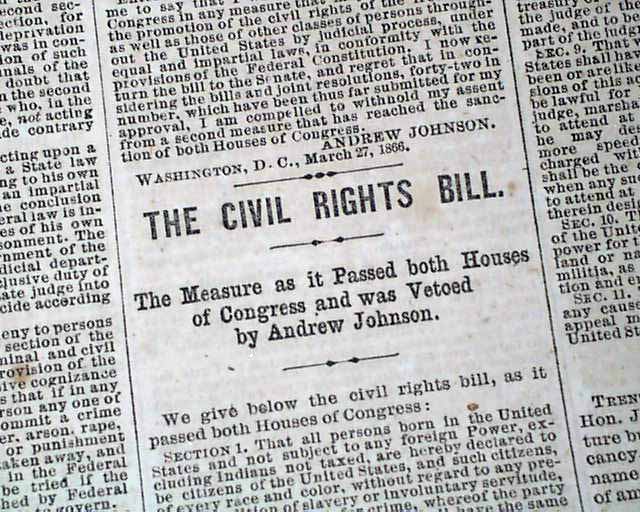
The text of the Civil Rights Bill of 1866
The Civil Rights Bill of 1866 is similar to the Seneca Falls Declaration since it was a step in the right direction for a group often discriminated against to being respected, or at least acknowledged, by the majority.


Monday, October 31, 2016

LAD #10: Monroe Doctrine


A cartoon depicting the main takeaway from the Monroe Doctrine
What did the issuing of the Monroe Doctrine express from an American perspective post War of 1812?
The War of 1812 started after Britain interfered with the United States by impressing sailors and not removing troops from US territory. The doctrine is stating that Europe should refrain from interfering with the development of America. America was tired of other countries trying to run America and treat it like a colony.

What was Secretary of State Adams' hope when he wrote the Monroe Doctrine?
Adams wanted Europeans to stop interfering with US affairs. He wrote that "it is impossible that the allied power should extend their political system to any portion of either continent, without endangering our peace and happiness." In addition, Adams wanted the US to maintain friendly relations with other nations while staying neutral, as written in the last sentence: "It is still the true policy of the United States to leave the parties to themselves, in the hope that other powers will pursue the same course."

What is the key phrase in the entire document that you need to remember as the cornerstone of American foreign policy?
The final sentence, quoted above, stating that America will remain neutral. This policy goes all the way back to Washington and his Neutrality Proclamation. America will leave the other nations alone, and hopefully they will reciprocate.
The "hands off" idea in the Monroe Doctrine cartoon above is often associated with laissez-faire
The doctrine asking other nations to leave America alone is similar to the idea of laissez-faire, in which people of a nation ask their government to stay out of business. Laissez-faire was advocated for during the Antebellum period, as southern planters wanted the government to remove tariffs on the exporting of their products.

Saturday, October 15, 2016

LAD #9

Thomas Jefferson
In his first inaugural address, Jefferson begins by saying that America is on the rise. It is expanding, great production is coming from the nation's manufacturers, and America is engaged in good trade. He continues, asking Americans to unite. Jefferson tells Americans not to let the political parties divide the people. He also advises citizens to trust the system of government in place, don't worry that the government doesn't have enough power. He said the government is quite strong because people respect the law and care about the good of the nation. Jefferson contrasts the state of America with the state of Europe, saying that life in America, particularly popular sovereignty, is great in comparison to the turmoil occurring in Europe at the same time. He says that America has many of the qualities necessary for a happy and prosperous nation, citing the great people and vast land. He then says the one thing that will complete the happiness of America is a government that prevents people from hurting each other, but does not regulate business, and does not tax too heavily. He says this is the epitome of a good government. He then goes over what he believes are the essential principles of the government. First, he says, is equal justice for all men, regardless of religion or political party. Then, honest friendship with all nations, and no entangling alliances. He also believes the support of the state governments is important, as well as preserving the government as the Constitution intends it to be. These principles are proven to be successful as they guided the nation through a revolution and the formation of our country. He finishes by saying he believes his prior experience in government has prepared him for this position, and asks in advance for forgiveness for any mistakes he will make in office. His goal in office is to maintain the approval of the citizens, which got him elected in the first place, and to bring happiness and peace to all Americans.

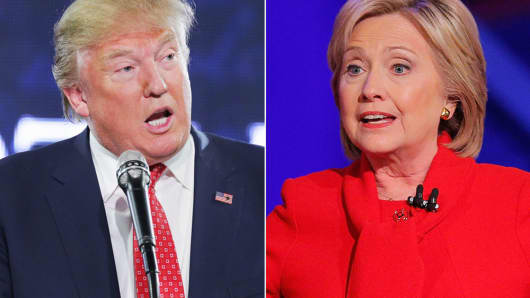
Donald Trump and Hillary Clinton
Jefferson asking Americans to unite and not let political parties divide the nation brings to mind the current Presidential election, where many people are so strongly in support of one candidate or the other that the parties may be dividing the nation once more, as they did in 1800, when Jefferson was elected.

Tuesday, October 11, 2016

Should Christopher Columbus be considered a hero or villain?

Christopher Columbus
Columbus should be considered a villain because he committed a holocaust of the Native Americans. Upon landing in the New World, Columbus instantly took natives as prisoners and forced them to take him to the source of gold. Throughout his expeditions, he took natives captive with each new island he hit, using them as slaves. Columbus made an outlandish promise of bringing back lots of gold that simply was not present in the region, so he made the natives find gold, and when they did not find enough, they had their hands amputated. If they fled, they were hunted down by dogs. Once the small amount of gold was picked over, the natives became slaves on encomiendas.
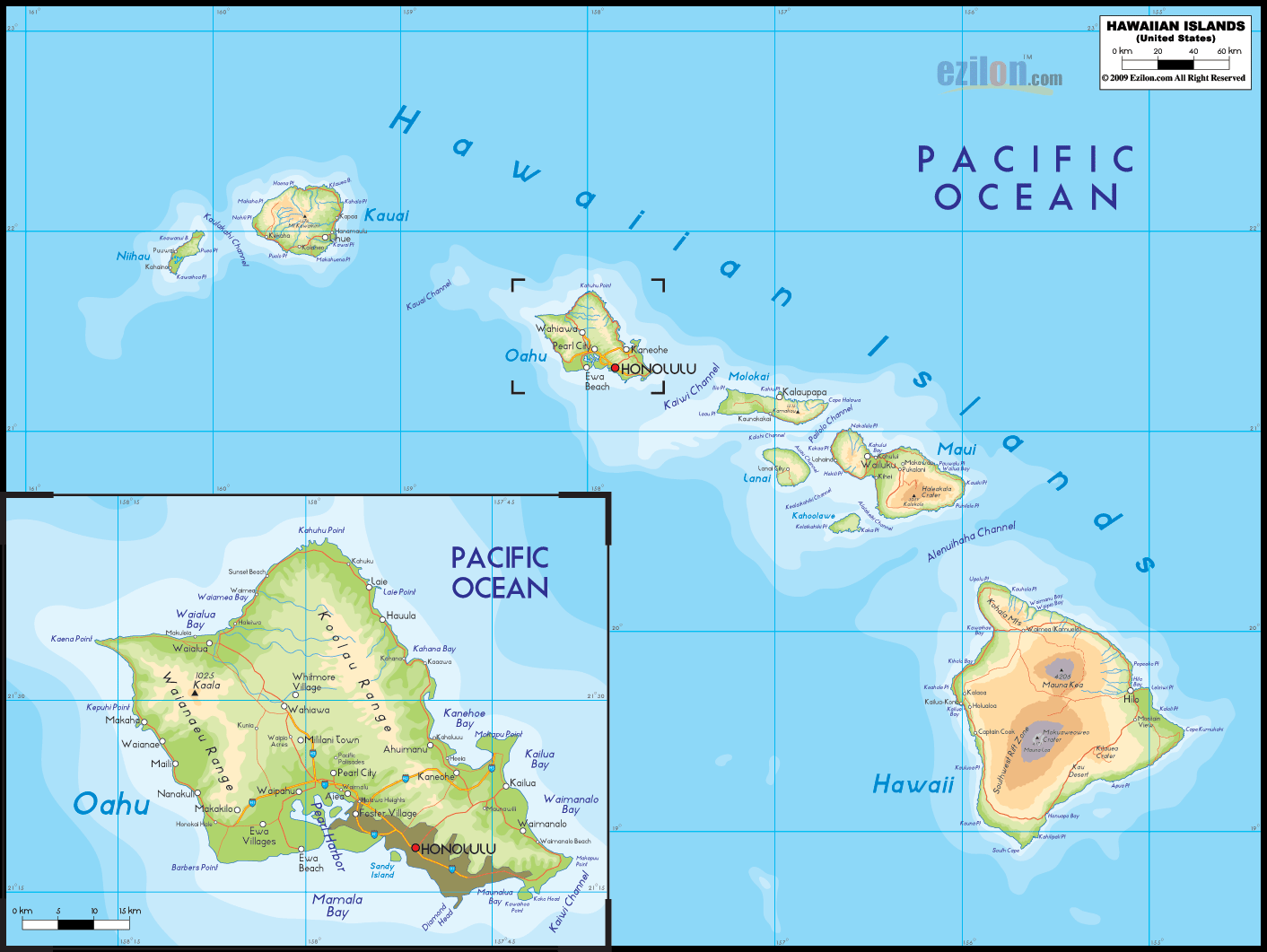
Hawaii
Columbus's encounter with natives is like American imperialism in Hawaii. In Columbus's voyage, he ended up in total control of the region, like the US controlled all of Hawaii's ports, buildings, and military equipment.