Thursday, January 19, 2017

LAD #28

Image result for woodrow wilson
Woodrow Wilson
In his First Inaugural Address, President Woodrow Wilson stated his desire for America to be the most charismatic nation, saying America needs "to cleanse, to reconsider, to restore, to correct the evil without impairing the good." He said that America has been heartless in in it's rush to become the greatest nation, and the people have only been worrying about their own well-being. With it's riches, America has become more wasteful and careless, and the government has been selfish as well, forgetting the people it is supposed to serve. But still, life is great for Americans as they have an abundance of wealth and diversity that was built up by the people themselves. He called his election a day of dedication to be good Americans.
Thomas Jefferson

Wilson's address is similar to Jefferson's First Inaugural Address since both stress that their victory was about more than a victory for their party. Wilson stresses how his presidency will be about all people and having good character and being unified as Americans, just like Jefferson advocated for unity when he said "We are all Republicans, we are all Federalists."

LAD #27

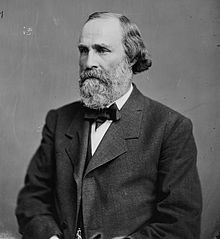
Henry De Lamar Clayton Jr., whom the act was named for.
The Clayton Anti-Trust Act added to the Sherman Anti-Trust Act's list of banned practices that restrict trade. Price discrimination, which is selling products at different prices for different people, was banned. Also, interlocking directorates were banned, which is when people serve on the board of trustees for multiple companies in competition. However, labor unions were exempted from being considered trusts, strikes became legal, as did peaceful picketing.
The logo for the Federal Trade Commission, which was established by the act.
The Clayton Anti-Trust Act is similar to the Federal Trade Commission Act (1914) since both outlawed unfair business practices and unfair methods of competition, which could hurt consumers.

Monday, January 16, 2017

LAD #26

King giving his famous speech
In his "I Have a Dream" speech, Martin Luther King Jr. spoke in support of racial justice. King first mentioned Abraham Lincoln, whose memorial he spoke in front of. He referenced the Emancipation Proclamation, Lincoln's call for the end of slavery, to say that the end of slavery was a step in the right direction, but there is still great strides that need to be taken in the fight for equality. He then discusses how the Declaration of Independence was a false promise for blacks, as they do not have full freedom to "life, liberty, and the pursuit of happiness." He calls these freedoms a "bad check" that blacks cannot cash, but are ready to cash in and reap the benefits. However, while equality should be a given right, he said that people cannot sit around and expect justice to happen - now was the time for change. At the same time, however, this fight for justice cannot lead to hatred and violence between races. He added that black people will not stop fighting until they receive equal treatment as white people. Finally, at the end of the speech, he repeats the famous phrase of "I have a dream." He uses this repetition to depict the great things that would happen if black people earned equality. People are judged for their character on the inside rather than the skin color on the outside. And he hopes that black and white people can be kind to each other and not create a divide over the fight for justice.
Sojourner Truth

King's speech is similar to Sojourner Truth's "Ain't I a Woman?" speech. In both instances a person is fighting for equality of a group that experienced injustice - in Truth's case, women, and in King's case, black people. In addition, both speeches are named and recognized for the repetition of a phrase that makes the speech powerful by showing the injustice or what could happen if the injustice was no longer.

Wednesday, December 21, 2016

LAD #25

Senator Henry Dawes, the author of the act bearing his name
The Dawes Act was an attempt to assimilate Native Americans into American society. Reservations were broken up into parts that were given to the head of each family, and each individual living alone. If they behaved (to American standards), the property became theirs and they became American citizens after 25 years. Leftover land was sold to fund government efforts to "civilize" the natives. The "Five Civilized Tribes" - the Cherokees, Creeks, Choctaws, Chickasaws, and Seminoles - were exempt from the act.
A depiction of "forty acres and a mule"
This act is similar to the "forty acres and a mule" that were given to newly freed black people after the Civil War. Like the Dawes Act, the federal government gave a marginalized group of people a plot of land to allow them to become a part of American society. Also, both efforts failed, as the land given in the Dawes Act was unsuitable for farming, and turned out to be too small, and President Andrew Johnson ended the forty acres policy, and many blacks had their land taken away as Johnson redistributed the land to whites.

LAD #24: Cross of Gold Speech

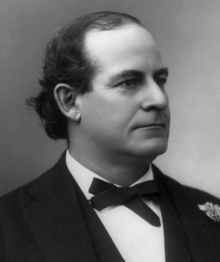
William Jennings Bryan
At the 1896 Democratic National Convention, William Jennings Bryan says that he supports free silver (bimetallism), since he believes it would bring the nation prosperity. He also strongly opposed gold, saying that America should not just have a gold standard because England does, and that America does not need help from another country to use silver ("let England have bimetallism because the United States have"). Bryan believes that America needs an Andrew Jackson to "stand . . . against the encroachments of aggregated wealth." Bryan then defends the income tax, saying it justly puts the burdens of the government on the backs of the people - the government protects the people, so it's fair that the people are paying the government back for their protection. He says that Democrats are against the bank currency, and again complements Jackson, saying that in destroying the bank he "saved America." This speech gave Bryan recognition and led to his nomination for President.
Andrew Jackson
Bryan's speech is similar to Specie Circular, issued by Andrew Jackson. In both instances, the men are advocating for a change in acceptable currency. Jackson requires gold or silver to buy land instead of paper money, while Bryan wants to change from a gold standard to bimetallism, in which silver is an acceptable currencty.

LAD #23: Populists

The Populist Party nominating convention in 1890
The Populist Party was formed to appeal to workers ("we seek to restore the government of the Republic to the hands of the 'plain people.'"). They wrote that workers should be able to unionize, and fought for a shortened workday and reasonable wages. The Populists favored an involved government, including government ownership of railroads, the telegraph, and the telephone. Also, they wanted restricted immigration - land owned by foreigners should be reclaimed by the government and given to "actual settlers." Plus, the Populists sought a more direct democracy - they wanted direct election of Senators, and a free ballot and fair count, expressing their displeasure with the corruption in elections. In addition, they demanded free and unlimited gold and silver coins, and thought that the country's money should be kept in the hands of the people - the state and national revenue should only be for the necessary expenses of the government - otherwise the money should be with the people.
Alexander Hamilton, a prominent Federalist
The Populist Party is similar to the Federalist Party, since both parties desired a strong central government influence in the lives of the people.

LAD #22: McKinley's War Message

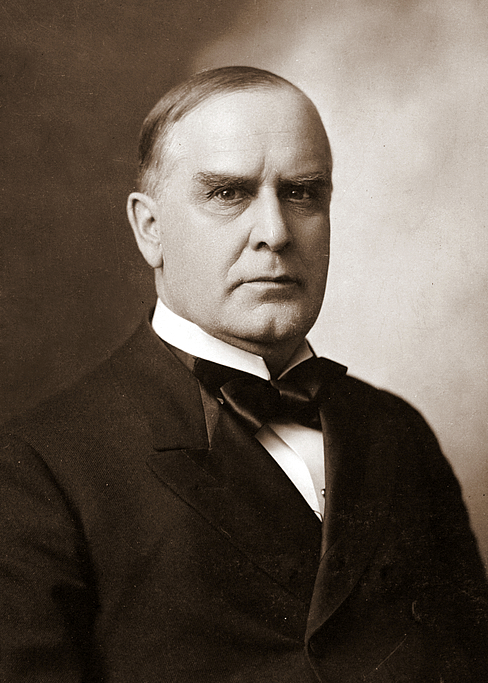
President William McKinley
McKinley says that the current revolution is just one of many that have occurred in Cuba against Spain over the last fifty years. The revolutions have been a lot of trouble for America, since the US had to enforce its neutrality laws, and the revolutions were a disturbance to the American people. And, American trade has been hurt by the revolutions, and the money that citizens invested in Cuba had been mostly lost. McKinley says that a victor in the war is unlikely, and what will probably occur is that one or both sides will get tired. He cited a previous speech in which he said that a proclamation of neutrality would not help towards calming the situation in Cuba, and he still believes this. He then suggests ways to help end the war - either as an impartial neutral, by suggesting a compromise, or as an ally of one of the countries. McKinley advocates for an armed intervention to free Cubans from the Spanish.
President James K. Polk
McKinley's War Message is similar to Polk's War Message since in both instances, the President recommends war to solve an issue that is detrimental to the American people. In Polk's case, there was violence on America's soil as America was in the fight for Texas, and in McKinley's case, the revolutions in Cuba are an irritation to the American people and have hurt trade and the finances of the people.